
'We need to raise the costs and consequences for Pakistan. It is long overdue. Our initial surgical strike was effective for about six months. Then, the Balakot strike provided a deterrent for perhaps two to three years. But we cannot operate under the assumption that such limited responses will suffice for decades to come.'
The Medal for Gallantry recipients also included Humayun Bhat, a deputy superintendent of police who was one of four officers to lay down their lives during an encounter with terrorists in south Kashmir's Kokernag in September 2023.
A top Pakistani commander of the terrorist group Lashkar-e-Taiba (LeT) who was active in the Valley for several years was killed and four security personnel were injured in an encounter in the Khanyar area of Srinagar on Saturday, officials said.
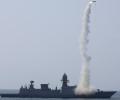
The visuals show the BrahMos anti-ship and anti-surface cruise missiles being launched from a fleet of warships, including Kolkata-class destroyers and Nilgiri and Krivak-class frigates, reaffirming the Navys operational prowess.
S&P Global Ratings on Thursday said the hostilities between India and Pakistan heighten risks to the credit metrics of both countries, and any escalation in clashes would put downward pressure on sovereign credit support.

'India for its survival has to change its doctrine from no first use to a pre-emptive attack in case of any hostile move by Pakistan,' recommends Colonel Anil A Athale (retd).

Moody's Ratings on Tuesday cut India's GDP growth projections for 2025 to 6.3 per cent, from 6.5 per cent, saying economies globally will see a slowdown on account of heightened US policy uncertainty and trade restrictions.

Prime Minister Narendra Modi on Friday said the world has seen the power of India's indigenous weapons during Operation Sindoor, which is 'not over yet'.
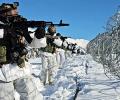
Pakistani troops violated the ceasefire along the Line of Control (LoC) in Poonch district of Jammu and Kashmir, prompting a strong response from the Indian Army. The incident, which occurred in the Krishna Ghati sector, comes a day after two Indian Army personnel were killed in an IED blast near the LoC. The ceasefire violation is the fourth cross-border incident in five days and the first this year.

Over 100 terrorists, including high-value targets such as Yusuf Azhar, Abdul Malik Rauf and Mudasir Ahmed, were eliminated during Operation Sindoor on May 7, the Indian military said on Sunday.

Ruckus prevailed in the Jammu and Kashmir assembly for the third day on Friday as Bharatiya Janata Party members protested over the special status resolution, leading the speaker to marshal out 12 opposition MLAs and Langate legislator Sheikh Khurshid.
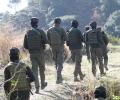
Security forces on Saturday extended the ongoing search operation to new areas after the body of the fourth policeman and two slain terrorists were recovered from the scene of a gunfight in a remote forested area in Kathua district of Jammu and Kashmir, officials said.
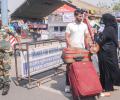
United States Charge d'Affaires Natalie Baker on Wednesday met Deputy Prime Minister and Foreign Minister Ishaq Dar as part of efforts to de-escalate tensions with India following the Pahalgam terror attack on April 22 in which 26 people were killed.
Security forces have intensified search operations using aerial surveillance and sniffer dogs following a night-long cordon after fresh reports of suspected movement of three individuals, believed to be terrorists, who escaped a recent encounter in Jammu and Kashmir's Kathua district, officials said.
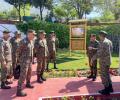
'Surgical strikes or air strikes, or both, are likely on the table.'

Puri said Pakistan was a country in "terminal decline" periodically using terrorism as an instrument of state policy.
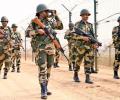
The Border Security Force has ordered mobilisation of additional manpower at posts along the India-Pakistan border in Punjab and Jammu as part of its measures to strengthen the anti-infiltration grid and check the intrusion of drones carrying ammunition or drugs, official sources said Monday.
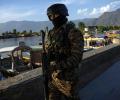
The 'mediation' by the United States from behind the scene on the diplomatic track appears to be once again working, which calls on both Delhi and Islamabad to show restraint and pull back from a military confrontation, notes Ambassador M K Bhadrakumar.
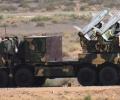
'The devastating Indian Air Force strikes on the night of May 9-10 exposed Pakistan's vulnerabilities.' 'If these had continued, it would have further degraded Pakistan's ability to continue with air operations.'

Defence attaches of several major countries who are part of many international groupings, as also of several Islamic countries attended the briefing, sources said.
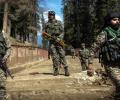
'If there is a military standoff eyeball to eyeball on the western border, the Chinese could create problems by making movements in the north, in our northeast, which could involve us tying down some forces there so that could stretch our military actions.'

Suspected drones were observed along the International Border in Samba district of Jammu region on Monday, while armed forces downed a 'surveillance drone' in Punjab's Jalandhar district.

Asserting that India will not tolerate any 'nuclear blackmail', Prime Minister Narendra Modi on Monday said operations against Pakistan have only been kept in abeyance and the future will depend on their behaviour.
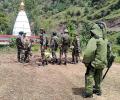
'Unfortunately, India and Pakistan could learn a 'lesson' from this conflict that will make them more likely to use these weapons against each other in the future.' 'Rounds of missile and drone attacks could be more routine features of their hostility, just like artillery fire has become a familiar fact of life along the Line of Control.'

Reddy alleged that contracts worth thousands of crores were awarded to people close to Modi, who then purchased Rafale aircraft.
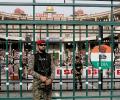
India registered its protest at the board of IMF, which met on Friday to review the EFF lending programme for Pakistan.
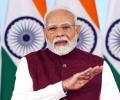
Presenting the full text of Prime Minister Narendra Modi's address to the nation on May 12, 2025, in which he dictated India's new doctrines on countering terrorism.
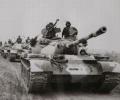
Why did Pakistan sign a cease-fire without acquiring Kashmir, which was the sole purpose of the 1965 War, asks Ahmad Faruqui.
'Whatever we do, the purpose will be to re-establish deterrence.'
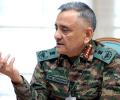
Chief of Defence Staff General Anil Chauhan on Saturday said India's Operation Sindoor has drawn a 'new red line' of intolerance against terror, and expressed hope that the military action has brought 'some lessons for our adversary also'.


Calm prevailed in Punjab, especially in the border areas of the state, on Sunday morning, following an understanding between India and Pakistan to stop all firings and military actions on land, air and sea.

Union Home Minister Amit Shah said on Friday that the Operation Sindoor undertaken by the Indian armed forces in retaliation for the Pahalgam terror attack has "completely exposed" the fact that terrorism in India is sponsored by Pakistan. Shah also said that the operation showed the "firm" political will of Prime Minister Narendra Modi, the "precise" intelligence inputs from agencies, and the "lethal" capabilities of the armed forces. He added that the operation was successful as it used the correct firepower and achieved its aims besides "showing the reality" to Pakistan.

'It is typical of China's strategic deception of making virtue out of necessity,' observes Rup Narayan Das.
The incident took place on the intervening night of April 8-9 near Dorangla village in Gurdaspur district. The Border Security Force (BSF) has issued an "alert" all along the 553 km of this front in Punjab and suspension of farming around the blast area.

More than 300 flights have been cancelled and at least 25 airports, including Srinagar, have been temporarily shut for operations amid restrictions in the wake of the armed forces launching missile attacks on terror targets in Pakistan on Wednesday morning.
'It could take the form of sporadic LoC violation through heavy artillery and mortar fire, focusing on border villages where the Hindu Dogra population is predominant.'
'There's something called deterrence by punishment.' 'That means you hit in a manner calculated to raise costs and consequences for Pakistan, so that the next time it attempts a Pahalgam-like attack, it has to think ten times.'

'It is important India to stay focussed on its primary national objectives: Combating terrorism; not losing sight of other security and strategic concerns (on the Sino-Indian front for instance); ensuring a strong economy and registering growth which includes improving the lot of common people; and finally making certain that the social fabric remains intact and harmony among people is not jeopardised, at least any further,' asserts Nilanjan Mukhopadhyay.

India has secured international support in its fight against terrorism, with Russia, Japan, and the United Arab Emirates expressing solidarity and a commitment to working together to combat the threat. This follows a recent terrorist attack in Pahalgam, India, which claimed 26 lives. Multi-party parliamentary delegations from India briefed the leaderships of these countries on Operation Sindoor, India's response to the attack, and discussed ways to enhance cooperation in counter-terrorism and combating radicalism. These developments highlight the growing global consensus against terrorism and the importance of international collaboration to address this shared challenge.
